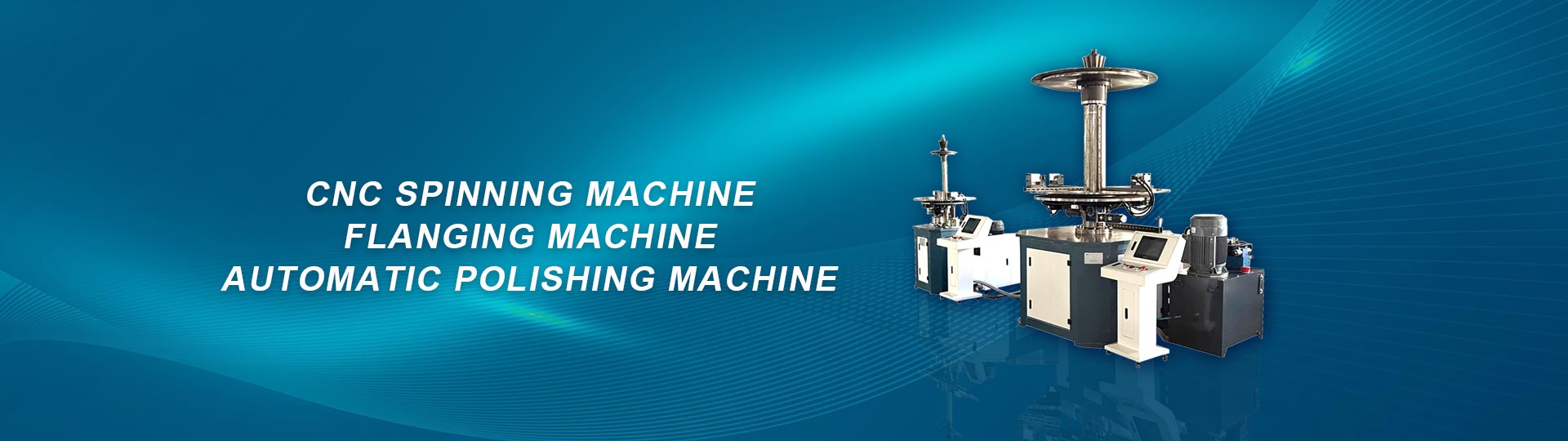
CNC metal spinning uses computer-controlled toolpaths to form rotating metal blanks, while conventional spinning relies more heavily on manual operator control. The main differences are automation, repeatability, production efficiency, and operator involvement.
CNC metal spinning is a metal-forming process in which a computer numerical control system directs the movement of forming rollers against a rotating metal blank.
The blank is clamped against a mandrel and rotated while the rollers follow programmed paths to gradually shape the material.
A CNC Spinning Machine can control important operating parameters, including:
Roller movement and forming trajectory
Spindle speed
Feed speed
Forming sequence
Tool positioning
Programmed production steps
Depending on the machine configuration, CAD-based programming, servo drives, and hydraulic systems can support accurate and repeatable forming operations.
CNC spinning is commonly used to manufacture hollow, symmetrical components such as cones, cylinders, reflectors, cookware, metal housings, and industrial parts.
Conventional metal spinning generally refers to a process in which the operator controls the forming tool manually or through a mechanically assisted spinning lathe.
A circular metal blank is clamped against a rotating mandrel. The operator applies pressure through a forming tool or roller, gradually moving the material against the mandrel until the required shape is produced.
The process depends heavily on the operator's experience, including the ability to control:
Forming pressure
Tool movement
Spindle speed
Forming sequence
Material deformation
Surface finish
Conventional spinning is useful for prototypes, customized components, repair work, and small production runs.
However, the term "conventional spinning" can also describe traditional spinning methods performed on powered lathes. Not every conventional machine is entirely manual; the key distinction is how much of the forming path and process is controlled automatically.
The main difference is how the forming operation is controlled. CNC spinning uses programmed toolpaths, while conventional spinning relies more on direct operator control.
| Comparison | CNC Metal Spinning | Conventional Metal Spinning |
|---|---|---|
| Tool movement | Computer-controlled programmed paths | Mainly operator-controlled |
| Process control | CNC system and preset parameters | Operator adjusts forming operation |
| Repeatability | High when programs and conditions are stable | Depends more on operator skill |
| Production efficiency | Suitable for repetitive production | Often more practical for one-off or small-batch work |
| Complex shapes | Programmed multi-stage paths can support complex profiles | Depends heavily on operator experience |
| Operator involvement | Setup, programming, monitoring, and inspection | Direct control of forming movements |
| Initial investment | Generally higher | Generally lower |
| Production flexibility | Program and tooling changes | Skilled operators can adapt movements directly |
Neither method is universally better. The right choice depends on product complexity, order quantity, material, required consistency, and manufacturing cost.
CNC metal spinning follows a controlled sequence that converts a flat metal blank into a hollow component.
A circular metal blank is cut to the required dimensions. A mandrel is selected according to the internal shape of the finished component.
The blank is positioned against the mandrel and secured using a clamping or tailstock mechanism.
The required product profile and forming sequence are entered into the CNC system.
Depending on the machine, the operator can use CAD-based programming, teach-in functions, or manual parameter input to define the roller trajectory.
The spindle rotates the blank while the forming roller moves along the programmed path.
The roller gradually presses the material against the mandrel. Multiple forming passes may be used to achieve the required geometry while controlling material deformation.
Depending on the machine configuration, additional operations may be available, including trimming, flanging, curling, and rolling.
These functions can reduce the need to transfer the workpiece between separate machines.
The finished component is checked for dimensions, surface condition, and other product requirements before removal.
For repeat production, the saved program can be recalled and adjusted when necessary to support subsequent batches.
CNC spinning offers several benefits for manufacturers producing repeated or geometrically complex components.
Once a suitable program and process have been validated, the machine can follow the same programmed toolpath across multiple workpieces.
This reduces variation caused by differences in manual tool movement.
Automated roller movement reduces the amount of continuous manual forming required.
For repeated production, stored programs can also reduce setup time when switching between previously validated products.
CNC systems can coordinate straight lines, arcs, and combined curves to produce different product contours.
This is useful for manufacturers producing cones, parabolic components, curved housings, and other hollow symmetrical parts.
Operators still need knowledge of material behavior, tooling, and process setup. However, the CNC system handles much of the repetitive roller movement.
This can make production less dependent on continuous manual forming skills.
Some CNC spinning machines can perform additional operations such as trimming, flanging, crimping, and rolling.
The availability of these functions depends on the machine's design and configuration.
Conventional spinning remains useful in manufacturing situations where flexibility and low initial investment are more important than automated repeatability.
It may be suitable for:
One-off components and prototypes
Small production quantities
Customized metal products
Components with frequent design changes
Jobs where an experienced operator can efficiently adapt the forming process
For these applications, the setup requirements of a CNC machine may not always provide sufficient economic benefit.
However, conventional spinning can require considerable operator skill, particularly when forming complex profiles or working with materials that are more difficult to deform.
Both methods can process a range of ductile metals, provided the material and machine capabilities are suitable.
Common materials include:
Aluminum: Lightweight and generally easy to form in suitable alloys and tempers.
Stainless steel: Offers corrosion resistance but may require higher forming forces and careful control of work-hardening.
Mild steel: Commonly used for industrial components and metal housings.
Copper: Offers good ductility and is used for decorative and electrical components.
Brass: Suitable for many decorative products and formed metal parts.
The difference is not simply which metals each process can handle. Material thickness, alloy condition, strength, work-hardening behavior, and component geometry determine the required forming force and process settings.
CNC control can improve the repeatability of a validated forming sequence, but it does not eliminate the need for correct material selection and process development.
CNC metal spinning can provide more consistent dimensional results in repetitive production because the roller follows a programmed trajectory.
However, CNC control alone does not guarantee higher accuracy.
Final part accuracy also depends on:
Machine rigidity and positioning accuracy
Mandrel and roller design
Material thickness and mechanical properties
Blank positioning and clamping
Toolpath design and forming sequence
Material springback and deformation
Inspection and process adjustment
A well-operated conventional machine can produce accurate components, particularly when an experienced operator is working with a suitable material and a relatively simple product.
The practical advantage of CNC spinning is its ability to reproduce a validated process more consistently across production batches.
CNC metal spinning is generally more suitable for repetitive production when manufacturers need consistent dimensions, controlled forming paths, and reduced manual intervention.
Conventional spinning can be more economical for prototypes, customized products, and smaller quantities.
| Production Requirement | More Suitable Method |
|---|---|
| Single prototype | Conventional spinning |
| Small customized batch | Conventional or CNC, depending on complexity |
| Repetitive medium-volume production | CNC spinning |
| Large-volume production of consistent parts | CNC spinning |
| Frequent changes to product geometry | Depends on setup and operator capability |
| Complex programmed profiles | CNC spinning |
Production volume is only one factor. Tooling cost, program development, material utilization, cycle time, and product tolerances should also be considered.
Dading provides CNC metal spinning equipment for different workpiece sizes, materials, and production requirements.
The DD-XY-600-1 Standard CNC Spinning Machine is designed for small and thin products made from aluminum, iron, and copper.
It is suitable for manufacturers producing selected lighting components, cookware, and other small metal products.
Dading's CNC Single Tool Type Spinning Machine has a published maximum spinning diameter of 1,200 mm.
Its listed material thickness capacities include:
Iron plate: up to 3 mm
Aluminum plate: up to 6 mm
Stainless steel plate: up to 2 mm
The machine also supports programmed forming and additional operations such as trimming, flanging, crimping, and rolling.
The CNC Heavy Duty Spinning Machine is designed for applications involving thicker workpieces and greater forming requirements.
Its published specifications include:
Iron plate: up to 5 mm
Aluminum plate: up to 10 mm
Stainless steel plate: up to 3 mm
Hydraulic pressing system
Six tool positions
These specifications refer to the listed machine configurations. Actual processing capacity depends on material grade, workpiece diameter, geometry, and forming conditions.
Manufacturers can explore Dading's complete CNC Spinning Machine range to compare available equipment.
Not exactly. CNC spinning is a type of automated metal spinning that uses computer numerical control to direct tool movement. Other automatic spinning machines may use mechanical, hydraulic, or other control systems without full CNC programming.
No. Conventional spinning may use powered lathes or mechanical assistance. The term generally distinguishes traditional operator-controlled forming from CNC-programmed tool movement.
It can help reduce process variation and material waste through controlled forming and repeatable toolpaths. However, material utilization also depends on blank design, product geometry, trimming allowance, and process optimization.
Yes. CNC systems can control multi-stage roller movements and programmed trajectories to form a range of hollow symmetrical profiles, including cones, cylinders, curved shapes, and parabolic components.
Yes, especially when the part geometry is complex or dimensional consistency is important. For very small quantities or simple customized products, conventional spinning may have lower setup costs.
Yes. CNC automation reduces the need for continuous manual forming, but operators still need to understand material properties, tooling, programming, machine setup, and quality inspection.
The choice should be based on product geometry, material, thickness, production quantity, dimensional requirements, and available manufacturing skills.
Conventional spinning can be practical for prototypes and customized low-volume work. CNC spinning is often a better fit when production requires repeatable forming paths, consistent product dimensions, and efficient batch manufacturing.
As a metal-forming machinery manufacturer, Dading recommends evaluating the actual workpiece before selecting equipment. Product drawings, material specifications, blank dimensions, and expected production volume provide a more reliable basis for machine selection than automation level alone.
Explore Dading's CNC Spinning Machine range to review available configurations for different metal-forming applications.